

Process & user experience design
Architecting end-to-end engagement journeys. Designing processes and user experiences grounded in real needs.
Designing a process or user experience means starting from people: understanding their real needs, mapping their journeys, identifying friction points, and designing solutions that genuinely work in context. A discipline that combines field observation, modelling and prototyping.
I work across a wide range of subjects: user journey design, internal process redesign, ecosystem mapping, digital or physical service design, and data collection device design. In all cases, the process begins with immersion in the real context.
For Michelin, the mission produced a dynamic stakeholder map of the sustainable long-distance mobility ecosystem for the Transport business line. For Air Liquide, design of the Researchers' Journey: modelling the experience of Research teams and identifying improvement levers. For UNIL, design of the university lecture capture process post-Covid.
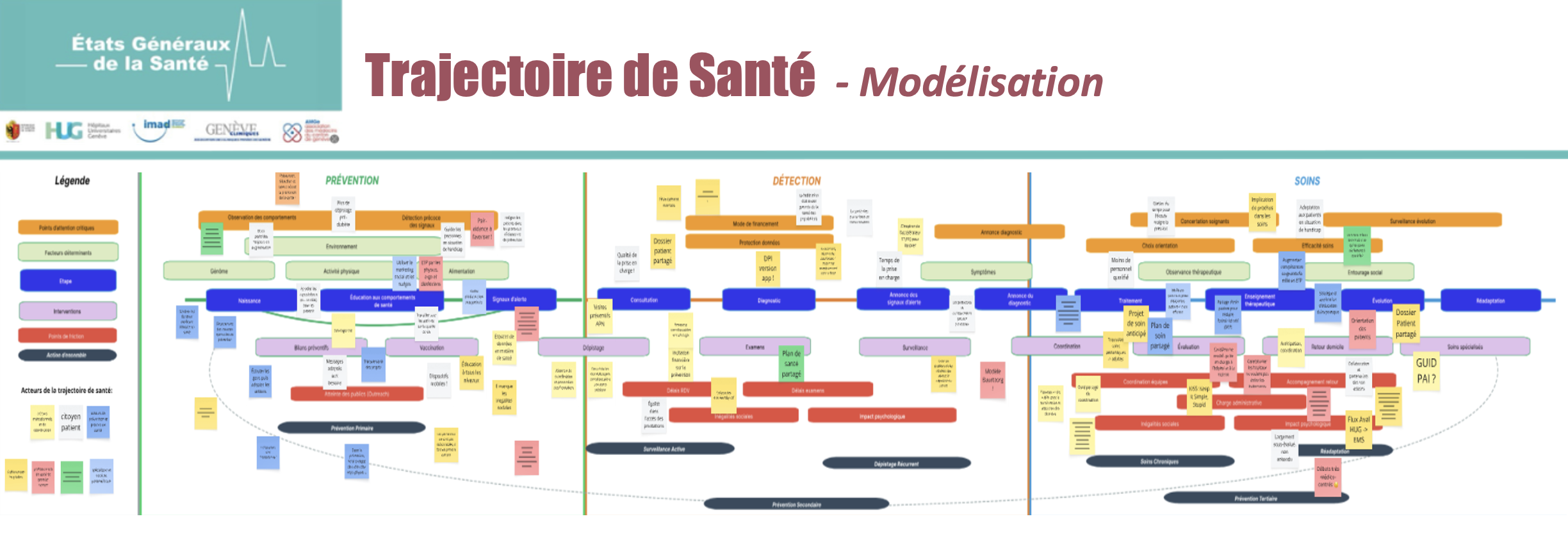
For the Direction générale de la Santé of the State of Geneva, process design missions around care coordination and health service organisation. For AP-HP, support for structuring innovation Labs and their interfaces with clinical teams. For Unicef, design of the Child Friendly Cities programme and its facilitation modalities.
For CNNum, contribution to prospective thinking on digital transformations, with modelling and visualisation deliverables. For CCIG, design of the innovation Lab device and its operating modes. For Vinci, design of the Design Lab Leonard's accompaniment processes and tools.
Cartier, Services Industriels de Genève, Total Energies, Ville de Genève, Forum Economique Mondial, BCGE, SNCF and Canton du Valais are also part of the portfolio.
Typical deliverables: journey maps, service blueprints, process models, stakeholder matrices, prototypes, functional specifications. Aimed at organisations seeking to improve their users' experience, simplify their processes or design a new service.